

EXPLORE, DESIGN, ADVANCE
ADVANCING HEALTH WITH INNOVATIVE TECH
Transforming Healthcare with Biomedical Engineering!
Bio-Medical Engineering
About the Department
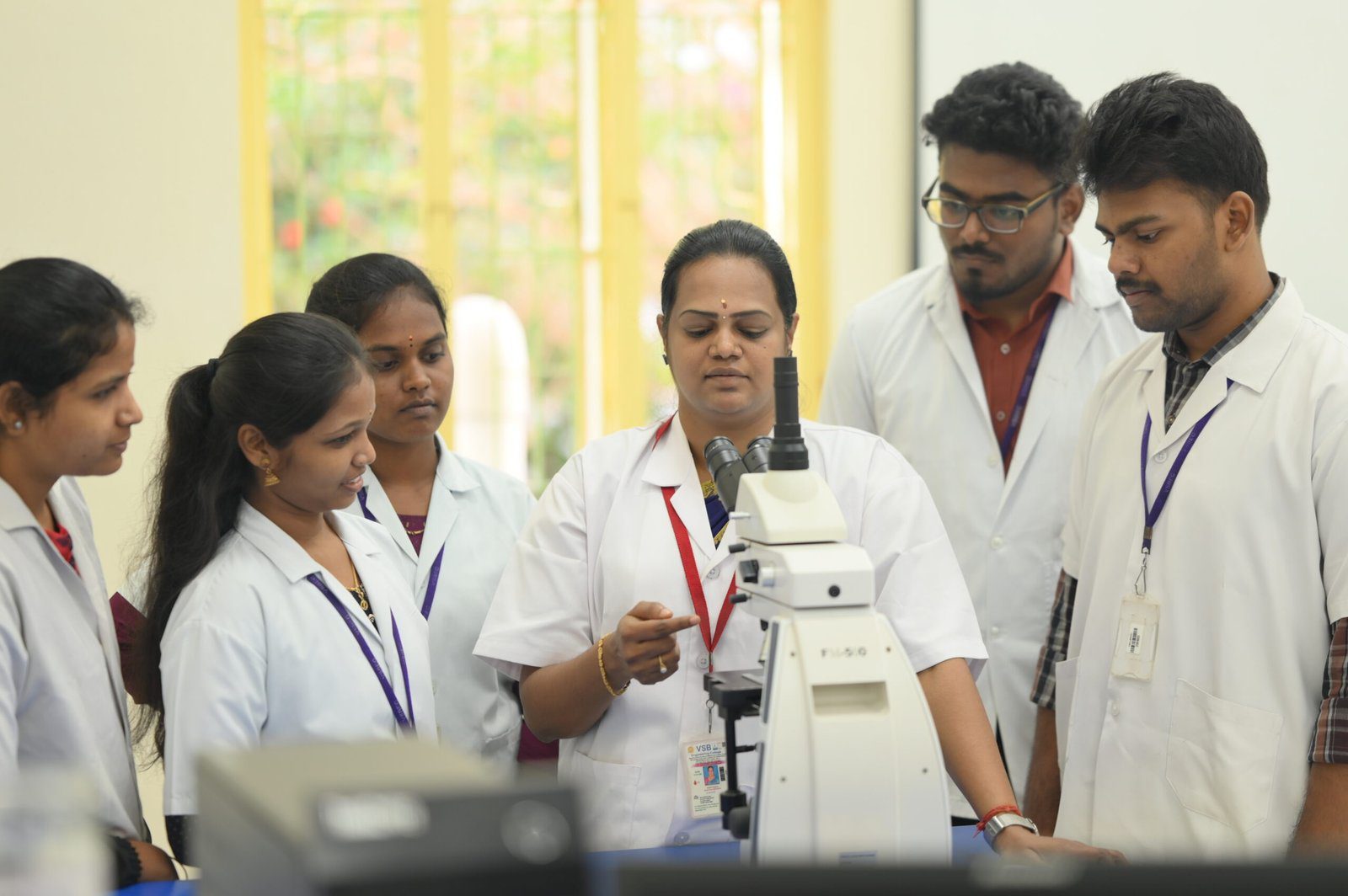
Biomedical engineering is an interdisciplinary program that combines engineering with biology to solve medical problems in living systems. The program aims to equip students with skills to develop new technologies for life saving equipment, biomedical instruments for treatment and diagnosis, physiological parameter monitoring using sensors, biomechanics, biomedical imaging, medical devices, cell and tissue engineering and more other medical applications. The course also aims at enabling the students to acquire technical skills for becoming experts in telemedicine, healthcare communication and medical informatics. The strong collaborative connection with academia, clinical medicine and industry offers opportunities for professional development and to gain unique knowledge and experience in the field.
OUR VISION & MISSION
- VISION
To create a center of academic excellence in the field of Biomedical engineering through innovative research contributions, industrial oriented teaching and training for betterment in healthcare.
- MISSION
- To motivate faculty members and students to explode their creativity to develop innovative products by utilizing modern technologies to serve the society.
- To inculcate the industrial need of the biomedical engineers among the students through relevant training and value added courses.
- To produce technically intense engineers by practicing innovative teaching methodologies.
Program Educational Objectives
PEO1
PEO2
To enable the graduates to exhibit leadership, make decisions with societal and ethical responsibilities, function and communicate effectively in multidisciplinary settings.
PEO3
PROGRAM OUTCOMES (PO)
1. Engineering knowledge: Apply the knowledge of mathematics, science, engineering fundamentals, and an engineering specialization to the solution of complex engineering problems
2. Problem analysis: Identify, formulate, review research literature, and analyze complex engineering problems reaching substantiated conclusions using first principles of mathematics, natural sciences, and engineering sciences
3. Design/development of solutions: Design solutions for complex engineering problems and design system components or processes that meet the specified needs with appropriate consideration for the public health and safety, and the cultural, societal, and environmental considerations
4. Conduct investigations of complex problems: Use research-based knowledge and research methods including design of experiments, analysis and interpretation of data, and synthesis of the information to provide valid conclusions
5. Modern tool usage: Create, select, and apply appropriate techniques, resources, and modern engineering and IT tools including prediction and modeling to complex engineering activities with an understanding of the limitations
6. The engineer and society: Apply reasoning informed by the contextual knowledge to assess societal, health, safety, legal and cultural issues and the consequent responsibilities relevant to the professional engineering practice
7. Environment and sustainability: Understand the impact of the professional engineering solutions in societal and environmental contexts, and demonstrate the knowledge of, and need for sustainable development
8. Ethics: Apply ethical principles and commit to professional ethics and responsibilities and norms of the engineering practice
9. Individual and team work: Function effectively as an individual, and as a member or leader in diverse teams, and in multidisciplinary settings.
10. Communication: Communicate effectively on complex engineering activities with the engineering community and with society at large, such as, being able to comprehend and write effective reports and design documentation, make effective presentations, and give and receive clear instructions.
11. Project management and finance: Demonstrate knowledge and understanding of the engineering and management principles and apply these to one’s own work, as a member and leader in a team, to manage projects and in multidisciplinary environments
12. Life-long learning: Recognize the need for, and have the preparation and ability to engage in independent and life-long learning in the broadest context of technological change
Program Specific Outcomes
PSO1
PSO2
PSO3
Academic Structure
Intake
Programme of Study
Description
STUDENTS DETAILS
| S. No | Year | Total | Boys | Girls |
|---|---|---|---|---|
| 1 | I BME | 61 | 29 | 32 |
| 2 | II BME | 55 | 21 | 34 |
| 3 | III BME | 45 | 20 | 25 |
| 4 | IV BME | 50 | 15 | 35 |
| TOTAL | 211 | 85 | 126 | |
MOU :
| Sl. No. | Name of the Company | Date of MOU | Valid |
|---|---|---|---|
| 1 | PINNACLE MEDICALS, MADURAI | 07.10.2021 | LIFE TIME |
| 2 | MEDDRAIN HEALTHCARE, ERODE | 16.08.2022 | 2022 – 2024 |
ROFESSIONAL MEMBERSHIP:
| S.No | Name of the Professional Body | No. of Students | Validity |
|---|---|---|---|
| 1 | ISTE | 49 | MAY’ 24 |
| 2 | International Chemical Biology Society | 100 | OCT’ 24 |

